


Understanding Hearing Aids
Modern hearing aids do far more than make sounds louder. They are sophisticated medical devices designed to improve access to speech, reduce listening effort, and support communication in everyday life. Choosing the right hearing aids involves much more than selecting a brand or technology level—it requires understanding your hearing, your lifestyle, and the environments where hearing matters most.
Whether you are exploring hearing aids for the first time or replacing existing devices, this guide explains how hearing aids work, how technology differs, what influences cost and value, when one or two hearing aids are recommended, and how thoughtful clinical prescribing helps achieve the best possible long-term outcomes.
Hearing Aids / Hearing Devices
What Are Hearing Aids?
Modern hearing aids are among the most sophisticated medical devices available today. Far more than simple amplifiers, they are designed to improve access to speech, reduce listening effort, and help people communicate more confidently in the environments that matter most. Advances in digital technology, artificial intelligence, wireless connectivity, and sound processing have transformed hearing aids into highly personalised rehabilitation tools that support both hearing and brain health.
However, choosing hearing aids is about much more than selecting a brand or purchasing the most advanced technology. Every person's hearing loss, communication goals, lifestyle, listening environments, and previous experiences are different. The hearing solution that delivers outstanding results for one individual may not be the best solution for another.
Successful hearing rehabilitation begins with understanding the person, not simply the hearing loss. A comprehensive assessment considers not only what you can hear, but how well you communicate in everyday life, the situations you find most challenging, and the outcomes that are most important to you. This information allows your audiologist to identify the technology most likely to provide meaningful benefit and long-term value.
At Deane Audiology, we believe the quality of the outcome is determined not by the hearing aid alone, but by the quality of the clinical decisions that guide its prescription, fitting, and ongoing support. Finding your Prescription Sweet Spot is the science. Curating your hearing solution is the art. Together, they create a personalised hearing rehabilitation plan that is clinically precise, individually meaningful, functionally beneficial, and designed to deliver exceptional long-term value.
Choosing hearing aids involves much more than selecting a device. Throughout this guide, we'll explain how hearing aids work, how technology differs, whether one or two hearing aids are recommended, what influences cost and value, and how thoughtful clinical prescribing helps maximise your long-term hearing success.
How Do Hearing Aids Work?
Modern hearing aids do far more than simply make sounds louder. They are sophisticated digital devices designed to improve access to speech while helping you hear more comfortably across a wide range of listening environments. Every hearing aid performs many thousands of calculations each second to analyse, process, and deliver sound that is personalised to your hearing needs.
The process begins with tiny microphones that capture sounds from the environment, including speech, background noise, and everyday environmental sounds. These sounds are converted into digital information and sent to the hearing aid's processor—the device's "brain."
Using your individual hearing prescription, the processor analyses the incoming sound and determines how it should be adjusted. It can selectively amplify speech, reduce unwanted background noise, manage sudden loud sounds, minimise feedback (whistling), and automatically adapt to changing listening environments. The sophistication of this processing is one of the key differences between hearing aid technology levels.
The processed sound is then delivered to a miniature receiver (speaker), which sends the carefully amplified sound into your ear. Rather than simply increasing volume, the goal is to restore access to the speech sounds that have become difficult to hear while maintaining comfort and sound quality.
The final, and most important, part of the hearing process occurs in the brain. Your ears collect sound, but it is your brain that interprets meaning, recognises voices, identifies where sounds are coming from, and separates speech from background noise. Hearing aids provide the brain with clearer, more complete sound information, allowing it to process conversations more efficiently and reducing the mental effort often associated with untreated hearing loss.
Modern hearing aids are therefore not designed simply to make sounds louder. They are designed to support your brain to hear more effectively. When professionally prescribed and carefully programmed, they become an important part of a personalised hearing rehabilitation plan that supports better communication, reduced listening effort, and long-term hearing and brain health.
Hearing Aid Technology Levels

One of the most common questions people ask is why hearing aids can vary so much in price. The answer is not simply that one hearing aid is "better" than another—it is that different technology levels are designed to support different listening needs.
All modern hearing aids are capable of amplifying sound according to your hearing loss prescription. Where they differ is in how effectively they help you hear in complex listening environments, particularly where background noise is present.
Entry-level technology is often well suited to people whose listening environments are relatively predictable, such as quiet conversations at home or small social gatherings. As technology levels increase, hearing aids become progressively more capable of analysing the listening environment, reducing unwanted background noise, enhancing speech, and automatically adapting to changing situations.
While hearing aid technology is important, its performance is only ever as good as the clinician designing and fitting the solution. Even the most advanced hearing aid cannot deliver its full potential if it is not carefully prescribed, programmed, verified, and optimised for the individual wearing it.
At Deane Audiology, we believe successful hearing rehabilitation begins long before a hearing aid is fitted. We invest considerable time understanding you—your hearing, communication goals, listening environments, lifestyle, personal preferences, and any previous experiences with hearing aids. We also use objective measures, including Live speech Mapping, Real Ear Measurement, Extended High Frequency diagnostics and QuickSIN® speech-in-noise testing where appropriate, to better understand the real-world listening challenges you face.
Rather than recommending the highest level of technology or the lowest-priced device, our aim is to identify the prescription sweet spot—the technology category that provides the performance you genuinely need, without paying for features that are unlikely to improve your everyday hearing experience. When this assessment is performed thoroughly and the technology is carefully matched to your needs, the result is often greater satisfaction, more consistent hearing aid use, and better long-term value.
And How To Avoid Wasting Money?
Are Hearing Aids Worth the Cost?

For many people considering hearing aids, the real question is not simply “How much do hearing aids cost?” but “How do I avoid spending money on hearing aids I won’t use?”
It is a valid concern. We regularly meet people who are hesitant because they know a friend, family member, or colleague whose hearing aids are now sitting unused in a drawer. Hearing aids can represent a significant investment, and nobody wants to spend money on technology that ultimately provides little meaningful benefit.
Whether hearing aids are worth the cost is ultimately a question of value, and value is personal. For one person, it may mean following family conversations again. For another, it may be hearing more confidently in cafe’s or at yoga, book club, or reducing listening fatigue, supporting tinnitus management, or remaining engaged and independent.
The important point is that hearing aid value is not determined by the device alone. Even highly sophisticated technology can disappoint if it is poorly matched to the person wearing it. Equally, the least expensive technology can represent excellent value when it genuinely meets that person's hearing and communication needs.
This is why we invest considerable time before recommending any technology. We first seek to understand your hearing, speech understanding in noise, communication goals, lifestyle, listening environments, preferences, budget, and any previous experience with hearing aids. This allows us to identify your Prescription Sweet Spot—the technology category most appropriate for your individual needs.
Only then do we carefully curate your hearing solution, designing the technology, physical and acoustic parameters, verification, rehabilitation, and ongoing support around you.
We are also not afraid to have honest conversations about disappointing hearing aid experiences you may have heard about—or experienced yourself. Understanding why some solutions fail is an important part of making better decisions.
The best value rarely comes from simply buying the most technology for the lowest price. It comes from making better clinical decisions from the beginning and creating a solution that is meaningful and beneficial for you and your needs, and is designed to deliver exceptional long-term value.
Finding your Prescription Sweet Spot is the science. Curating your hearing solution is the art. To avoid wasting time and money, and wasting the opportunity for living with better hearing and all the benefits that go with that, please chat to an Audiologist who puts you and these factors first - often, this may be an independent Audiologist (but not always). We recommend shopping around for a great clinician, before working out if and what hearing technology you might need because a great clinician can very often do more with less!
How to Feel Confident You’ll Get a Great Outcome & Not Waste Money
How Do I Know When I Have Found a Great Audiologist?

Choosing a hearing aid is important, but we think choosing the right audiologist is even more important. Modern hearing technology is remarkably capable, yet its performance depends heavily on the skill, clinical judgement, and care of the person prescribing, fitting, and supporting it with you.
A great audiologist should be interested in far more than your audiogram. They should take time to understand you—your communication difficulties, lifestyle, listening environments, goals, preferences, budget, and any previous experience with hearing devices. You should feel that they are trying to understand the problem before recommending the solution.
You should also feel comfortable talking openly about any fears you have or negative stories you have heard from friends, family, or colleagues. If you feel heard rather than dismissed, you may have landed on the right clinician for you.
They should also be able to explain why they are recommending a particular approach. Why this manufacturer? Why this technology category? Why one hearing aid or two? What are you paying more for at a higher technology level, and are you genuinely likely to benefit from it? A good recommendation should make sense to you.
Look for an audiologist who uses objective clinical information alongside your personal experience. Depending on your needs, this may include speech-in-noise testing such as QuickSIN®, comprehensive diagnostics, and objective verification using Real Ear Measurements and Live Speech Mapping. Just as importantly, they should listen carefully to what you experience in the real world and be prepared to refine the solution over time.
Follow-up care should also be paced appropriately for you. Some experienced hearing aid users require fewer consultations or less time between visits because their previous experience helps them identify what is—and is not—working more quickly. Others need more time, not only to learn and adapt, but to encounter the real-life situations in which they expect to hear better. Not everyone goes to a busy restaurant every week. Meaningful fine-tuning requires meaningful experience.
A great audiologist should also be comfortable having difficult conversations. They should acknowledge and explain the limitations of hearing aids, discuss disappointing experiences you may have heard about from others, and set realistic expectations without diminishing the potential benefits of better hearing.
Independence can be an advantage because it may provide access to a wider choice of manufacturers and reduce the potential for prescription bias. However, independence alone is not a guarantee of quality. The clinician's competence, curiosity, transparency, genuine care, and commitment to your long-term outcome matter most.
Perhaps the simplest test is this:
Do you feel the audiologist is trying to understand you—or do you feel they are trying to sell you something?
A great clinician will help you understand your options, identify your Prescription Sweet Spot, and only then curate the hearing solution around you—if and when you are ready. They will not be afraid to recommend less technology when less is enough, or explain clearly when investing in more is likely to provide meaningful functional benefit.
Shop for the clinician before you shop for the hearing aid. A great audiologist can often do more with less.
Hearing Aid Costs in Australia
Hearing aid prices in Australia vary considerably, and it can be difficult to understand why one solution costs more than another. The difference may reflect the technology level, manufacturer, style, accessories, or the professional care included. For this reason, comparing hearing aids on price alone rarely tells you whether one option represents better value.
Sometimes the least expensive technology is entirely adequate. If your listening environments are relatively predictable and your communication needs are straightforward, paying more may provide little meaningful additional benefit. In this situation, a lower-cost solution can represent excellent value.
Sometimes, however, it is not enough. A person who regularly communicates in complex background noise may require more sophisticated processing to achieve the functional improvements they expect. Choosing the lowest price in this situation may save money initially but provide poor value if the hearing aids do not adequately support the environments that matter most.
The opposite is also true: the most expensive technology is not automatically the best choice. Paying for the highest level of processing makes little sense if your hearing, lifestyle, and listening requirements mean you are unlikely to benefit from it.
Equally, choosing less expensive technology, less professional support, or a different purchasing pathway may be entirely appropriate. Some people may choose to purchase hearing devices online or through a mail-order service, while others may consider using devices previously worn by a friend or family member. Depending on the individual, the device, the hearing loss, and the intended use, these may provide practical, lower-cost options.
What matters is informed choice. Purchasing a device without an audiologist's assessment and prescription may reduce cost and increase convenience. The trade-off may be less certainty about whether the device is appropriate for your hearing, whether its technology can meet your communication needs, whether it is likely to harm your underlying hearing, whether its physical and acoustic design is suitable, and whether its performance has been objectively verified. You may also have less access to professional guidance, fine-tuning, rehabilitation, and support if things do not go as expected.
The difficulty is that many people do not yet know what they want from a hearing solution—and we would not expect them to. Hearing loss often develops gradually, and people adapt around it. Over time, some lose confidence not only in their hearing, but also in judging what they are missing, what could realistically improve, and which option is right for them. Our role is not to tell you what you should buy. It is to help you understand your hearing, clarify what is possible, and explain the benefits, limitations, costs, and trade-offs of the available pathways so you can make a more informed decision.
At Deane Audiology, we are clear about what we offer and why we believe it matters. We invest time in understanding you, use objective clinical information to identify your Prescription Sweet Spot, and only then curate a hearing solution around your individual needs. This is not simply about finding the best financial value. It is about optimising access to communication, reducing unnecessary listening effort, supporting participation and confidence, and maintaining access to meaningful sound as part of a proactive approach to long-term hearing and brain health.
The lowest price and the best value are not always the same thing. Sometimes less technology and less support are entirely enough. Sometimes they are not. The value of an informed decision lies in understanding what you need, what each pathway can realistically offer, and what matters most to your life.
Understanding the Benefits of Binaural Hearing
One Hearing Aid or Two?

If there is hearing loss in both ears, we are commonly asked whether one hearing aid is enough or if two hearing aids are recommended.
The answer depends on your hearing levels, communication needs, lifestyle, and personal preferences. However, when hearing loss affects both ears, wearing two hearing aids is often the most natural and effective solution.
Human hearing is designed to work as one system. Your brain constantly compares sounds arriving at each ear to determine where sounds are coming from, to separate speech from background noise, and create a balanced listening experience. When both ears contribute equally, or near equally, hearing is generally more natural, more accurate, and requires less listening effort.
Using two hearing aids offers several important benefits. Many people experience (1) improved speech understanding, particularly in noisy environments such as cafe’s, restaurants, family gatherings, and meetings. (2) Sound localisation is often better, making it easier to identify where voices, traffic, alarms, or other sounds are coming from. Two hearing aids can also create a more (3) balanced listening experience by reducing the sensation that all sound is coming from one side.
There are also potential long-term considerations. When hearing loss is present in both ears but only one ear receives amplification, the unaided ear receives less auditory stimulation. While every situation is different, many hearing professionals aim to maintain stimulation to both ears whenever appropriate, and this is certainly our approach too, as we take a long-term whole-person wellness perspective. There are important brain health considerations, not least, and you can read more on this here.
That said, two hearing aids are not always necessary. Some people have hearing loss in only one ear, significantly different hearing levels between ears, medical considerations, or personal circumstances that may make a single hearing aid the most appropriate option.
The goal is not simply to wear more technology. The goal is to achieve the best possible hearing outcome. A comprehensive hearing assessment can determine whether one or two hearing aids are likely to provide the greatest benefit for your individual hearing needs.
For most people with hearing loss in both ears, two hearing aids offer better acoustic balance, improved communication, and a listening experience that more closely reflects the way the brain naturally processes sound. We’ll gladly discuss your situation with you directly.
Why Does the Brain Prefer Two Hearing Aids?

Binaural hearing is the brain's remarkable ability to receive, compare, and integrate sound arriving at both ears into a single listening experience. The brain is extraordinarily sensitive to the information received from the left and the right. Most sounds arrive at one ear at a slightly different time than to the other. The brain can detect these differences in the arrival time of sounds measured in millionths of a second. These subtle cues allow us to locate sounds, judge distance and direction, and focus on speech even when background noise is present. These minute differences allow the brain to determine where sounds are coming from, separate speech from background noise, and create a stable, three-dimensional perception of the world.
This two-ear system provides important advantages in daily life. It improves spatial awareness, making it easier to locate approaching vehicles, identify the direction of a someone speaking, or determine where everyday sounds are coming from. It also enhances speech understanding in background noise, allowing the brain to focus more effectively on conversations in restaurants, family gatherings, meetings, and other acoustically challenging environments.
When hearing loss affects both ears, providing appropriate amplification to each ear helps preserve this natural balance of auditory information. Rather than simply making sounds louder, two hearing aids work together as one optimal system, enabling the brain to make better use of the information it receives, often resulting in more comfortable listening, reduced listening effort, and a more natural hearing experience.
What Are the Benefits of Wearing Two Hearing Aids?

When hearing loss affects both ears, wearing two hearing aids often provides benefits that extend well beyond simply making sounds louder. Because the brain is designed to receive and process sound from both ears simultaneously, amplifying both ears allows it to make better use of the auditory information it receives.
For many people, this results in improved speech understanding, particularly in challenging listening environments such as restaurants, meetings, family gatherings, and community events. Two hearing aids also improve sound localisation, making it easier to identify where voices, approaching vehicles, alarms, or other important sounds are coming from.
Many people also report reduced listening effort. When the brain receives a balanced signal from both ears, it generally expends less energy trying to fill in missing information, which can reduce the mental fatigue often experienced after prolonged conversations or social occasions.
Another important advantage is a more balanced and natural listening experience. Rather than hearing predominantly from one side, two hearing aids provide more even auditory stimulation, allowing sounds to feel fuller, more comfortable, and more representative of the way hearing is naturally designed to function.
While every person's experience is different, individuals with hearing loss affecting both ears often achieve the best communication outcomes when both ears are appropriately amplified.
Is One Hearing Aid Ever Enough?

Yes. Although two hearing aids are commonly recommended for binaural hearing in situations when there is a bilateral hearing loss, there are situations where a single hearing aid may be the most appropriate solution.
People with hearing loss affecting only one ear may require only one device. Likewise, individuals with markedly different hearing levels between ears, certain medical conditions, or specific anatomical considerations may benefit from an alternative approach based on their clinical circumstances.
For some people, practical considerations such as dexterity, vision, previous hearing aid experience, or financial circumstances may also influence the initial recommendation. In these situations, a staged rehabilitation approach may be appropriate, with the option of introducing a second hearing aid at a later stage if clinically indicated.
The objective is never to prescribe more technology than is necessary. Instead, our recommendations always reflect your hearing needs, communication goals, and the likelihood of achieving meaningful long-term benefit. These are things that we can measure. We measure, we never guess!
One Hearing Aid vs Two - How Do I Decide?

The decision to recommend one or two hearing aids is based on far more than the hearing test alone. While the audiogram provides valuable information about the degree and pattern of hearing loss, it represents only one part of the clinical picture.
An experienced audiologist also considers how hearing loss affects your everyday life. This includes the situations where you most want to hear well, the environments you spend time in, your communication goals, previous hearing aid experience, manual dexterity, and personal preferences.
Importantly, we never believe these decisions should be rushed. Hearing aids represent a significant investment in time, money and brain health outcomes, and spending more time at the beginning of the process always leads to better long-term results.
At Deane Audiology, we place particular emphasis on understanding your real-world communication requirements, rather than simply selecting technology from an audiogram. Objective measures such as your QuickSIN® speech-in-noise assessment help us understand exactly how much difficulty background noise creates for you, while detailed discussions about your lifestyle reveal where improved hearing will make the greatest difference.
This allows us to prescribe hearing technology based on your actual listening demands rather than assumptions. Some people genuinely benefit from advanced noise management and directional microphone systems because they regularly communicate in complex acoustic environments. Others may achieve excellent outcomes with more modest technology because their listening requirements are less demanding.
The objective is to identify the prescription sweet spot—a hearing solution that provides sufficient technology to meet your communication needs without paying for features that are unlikely to provide meaningful additional benefit. This careful assessment is one of the most important factors influencing long-term hearing aid satisfaction, consistent daily use and value.
Choosing the Right Solution for Your Hearing

There is no universal answer to which hearing aid, technology level, or purchasing pathway is right for you. You may not know whether you need one hearing aid or two, how much technology you are likely to benefit from, what level of professional support you want, or even whether hearing aids are the right next step. We would not expect you to arrive knowing these things.
For many people, hearing loss has developed gradually over years. You may have adapted without realising how much has changed, lost confidence in certain listening situations, or simply become unsure about what better hearing could realistically make possible. The first step is not choosing a hearing aid. It is understanding your hearing, clarifying what matters to you, and exploring the available options without pressure to make an immediate decision.
Our philosophy is to invest time before any purchasing decision is made. We want to understand your hearing, speech understanding, listening environments, expectations, previous experiences, personal preferences, and communication priorities. This helps us explain what different pathways may realistically offer and allows you to make a more informed choice.
If a professionally prescribed hearing solution is right for you, our first task is to identify your Prescription Sweet Spot—the technology category most likely to provide meaningful functional benefit without paying for performance you are unlikely to use. Only then do we carefully curate the hearing solution itself around you.
The right solution may be simple or sophisticated. It may involve one hearing aid or two. It may require more support or less. What matters is that the choices are understood, the solution is individually meaningful, and the outcome improves the parts of life that matter to you.
Finding your Prescription Sweet Spot is the science. Curating your hearing solution is the art. Together, they create a hearing rehabilitation plan designed to be individually meaningful, functionally beneficial, and of exceptional long-term value.
Why Professional Prescription Matters
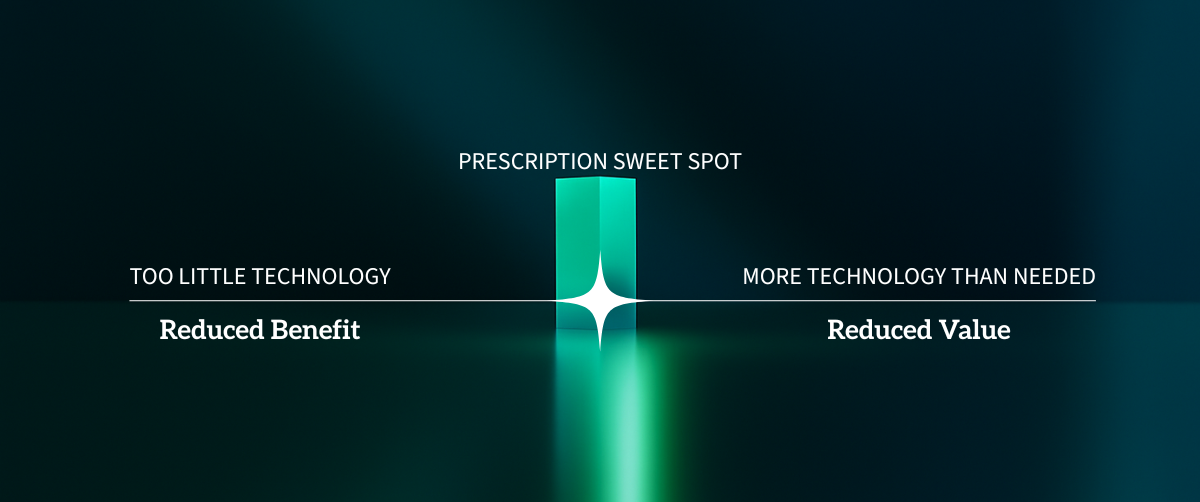
The Prescription Sweet Spot
Modern hearing aids are remarkably sophisticated, but technology alone does not determine the outcome. Long-term success depends on how thoughtfully the technology is prescribed, how carefully the hearing solution is curated, and the clinical expertise used to design, verify, and support it.
At Deane Audiology, our first goal is to identify your Prescription Sweet Spot: the technology category that best matches your hearing profile, communication needs, lifestyle, listening environments, preferences, and budget. Too little technology may leave you struggling in situations that matter to you, while more technology than you are likely to benefit from may not represent the best long-term value.
Finding this balance requires far more than an audiogram. It takes time to understand your communication goals, previous hearing aid experiences, speech understanding in noise, and the environments in which you live, work, and socialise. Only then can technology be prescribed with confidence.
Once your Prescription Sweet Spot has been identified, we carefully curate the hearing solution itself. This includes selecting the most appropriate technology, physical design, acoustic coupling, receiver or power requirements, and other elements that influence comfort and performance. The acoustic parameters are then individually designed, professionally programmed, objectively verified, and refined around your real-world experience during the trial period.
We believe the best hearing aid is not necessarily the newest, the most advanced, or the most expensive. It is the one that forms part of a thoughtfully prescribed and expertly curated solution—one that is means something to you and addresses your expected benefits, and designed to deliver exceptional long-term value.
Ultimately, we do not simply fit hearing aids. We design personalised hearing solutions around the outcomes that matter to you. That may mean clearer speech and easier communication, reduced listening effort, support for tinnitus management, or maintaining better access to sound as part of a broader proactive approach to hearing and brain health.
Finding your Prescription Sweet Spot is the science. Curating your hearing solution is the art.
What to Expect When You Start with Hearing Aids

Starting to wear hearing aids is not simply a matter of making sounds louder. It is a process of reintroducing the brain to sounds that may have gradually become quieter or less distinct, less clear, over many years. For some people, the change feels immediately positive. For others, it takes time for the new soundscape to feel natural. Both are normal responses.
At first, everyday sounds will be more noticeable - sounds you would ordinarily not likely notice. Your own voice will have a different tone to it, footsteps, running water, cutlery, birds, or the indicator in the car may sound different from what you remember. This does not necessarily mean something is wrong. As the brain receives more complete sound information again, it gradually learns what deserves attention and what can return to the background.
This process is often called acclimatisation. However, we do not believe every concern should simply be dismissed with, “You need to get used to it.” Hearing aids should be comfortable, appropriately prescribed, and delivering meaningful benefit. If sound is persistently uncomfortable, unnatural, or unhelpful, then further adjustment, counselling, and/or problem-solving is needed. But certainly more time is required, and again, is normal.
This is why the work completed before you receive your hearing aids matters so much. By first identifying your Prescription Sweet Spot, we can then carefully curate your hearing solution around your hearing, communication needs, listening environments, preferences, and previous experiences. This offers a stronger foundation for successful adaptation from the beginning.
Your early review appointments are an important part of the process. We want to understand what you are experiencing in the real world: what is working well, where you are still struggling, and whether the technology is delivering the functional benefit we expected. Fine-tuning is guided by your feedback, objective verification, and the communication goals we established together. We can, and do, measure progress.
Successful hearing rehabilitation is rarely about achieving perfection on the first day. It is about creating the right starting point, allowing the brain time to adapt, and refining the solution as your listening experience develops.
Finding your Prescription Sweet Spot is the science. Curating your hearing solution is the art. Ongoing care is how we help that solution become meaningful, functionally beneficial, and valuable for the long term.
“Rachel gave a wide choice of hearing devices from multiple manufacturers with a range of prices from which to choose depending on my resources and preferences. The chosen Hearing aids were set up by Rachel and I now also have some very useful controls through an App on my Phone. This has been an very successful process and it was all due to Rachel Deane Audiology - Thankyou.”
– A Payne, Chairman